Shivanga literally means “a limb of Shiva”. Shivanga Sadhana is a 42-day spiritual practice meant to strengthen one’s connection with the source of creation and to bring devotion into the mind. Done properly, it builds a stronger body and a steadier mind, and it opens a way to receptivity and deeper experience.
In 2020, I began the sadhana 42 days before Mahashivratri. It ended in Tamil Nadu, with a night climb of the seven Velliangiri hills and the Mahashivratri celebration at the Isha Yoga Center near Coimbatore. This is an account of those 42 days and the journey that completed them.
What the 42 days asked of me
Each morning began with worship using prescribed verses. Afterwards, I drank a glass of lemon water mixed with honey and about ten black peppercorns that had been soaked overnight. Breakfast was two or three neem leaves and a handful of raw groundnuts.
The rest of the day followed simple rules:
- Two meals a day, both strictly vegetarian, with the first meal not before noon.
- No alcohol, tobacco or other intoxicants of any kind.
- A bath twice a day using a herbal bath powder.
- After sunrise or sunset, 21 continuous rounds of Shiva Namaskar, a yogic practice performed while chanting a specific verse. It is meant to build energy in the body.
- A single-strand rudraksha mala and a strip of black cloth tied around the arm, worn for all 42 days.
One rule was unlike the others. Each practitioner must seek alms from at least 21 people, wearing a single unstitched cloth.
Asking for alms in Sipajhar, Assam
About a week before the journey, I decided to go to Sipajhar in Darrang district to seek alms. I bathed early and set off.
Starting was far harder than I had imagined. When I reached Sipajhar, questions, hesitation and doubt closed in on me. I sat in the car for a long time, lost in my own thoughts. Perhaps it would have been easier in a shirt and trousers. For nearly an hour I argued with myself. In the end I steadied my mind and stepped out, wearing only the dhoti.
Believe me, I was deeply embarrassed inside. I began with one or two shops and moved on, answering all kinds of questions from different people. Not one person made an unkind remark, and not one refused me. It was a strange and humbling experience.
This part of the sadhana exists to break down false pride, and I now think it is something many of us need. Arrogance can never be an ornament. The money collected in a special bowl is offered on Mahashivratri and used to feed people in need. I collected alms from more than 21 people and returned home.
Velliangiri, the Kailash of the South
The Velliangiri hills in Tamil Nadu are also known as Thenkailayam, the Kailash of the South. They are believed to be a sacred abode of Shiva in his self-manifested form. According to belief, Shiva found the place congenial for his austerities, and its climate is said to resemble that of Mount Kailash. The slopes are covered in trees and plants, many of them with medicinal properties.
The large ashram established by Sadhguru lies at the foot of these hills.
Arriving at the Isha Yoga Center
On 17 February 2020 I flew to Bengaluru and travelled on to Coimbatore. At that point the Covid-19 pandemic had not yet taken hold in India; the only case I had heard of was a person in Kerala. The city of Coimbatore is about 40 km from the Velliangiri hills, and we had booked our stay and meals at the ashram online.
Pilgrims had come from across India and abroad, and almost everyone wore a quiet, contented smile. Several large tents had been put up for us, and the arrangements for living and eating together were very well organised.
The ashram looks out over the hills, with greenery on every side. There are small cottages and huts, and a vegetarian dining hall. The Chandrakund, the Suryakund and the Dhyanalinga are hard to look away from; every detail seems carefully planned. Preparations for Mahashivratri were already under way, and bullock carts carried visitors around the large campus.
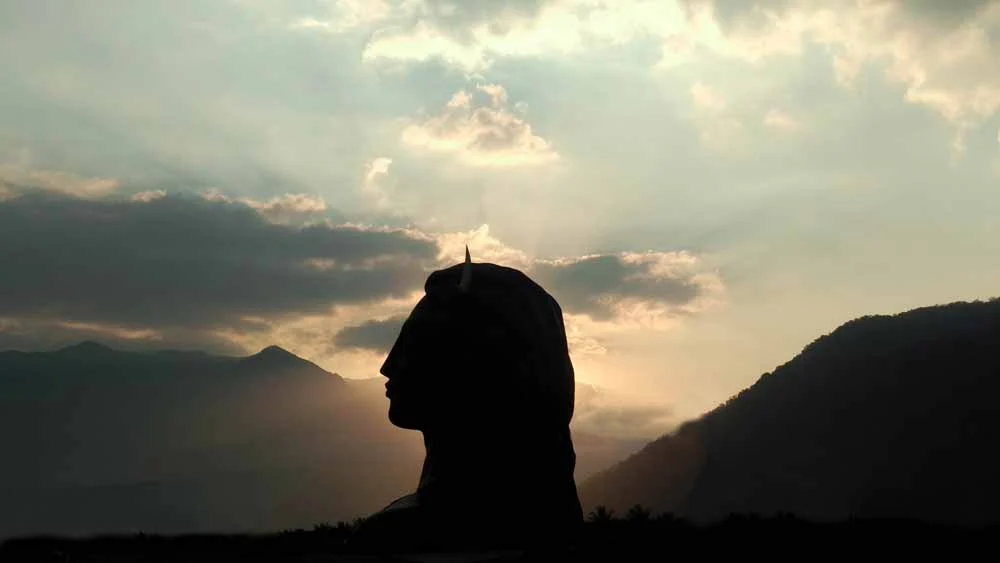
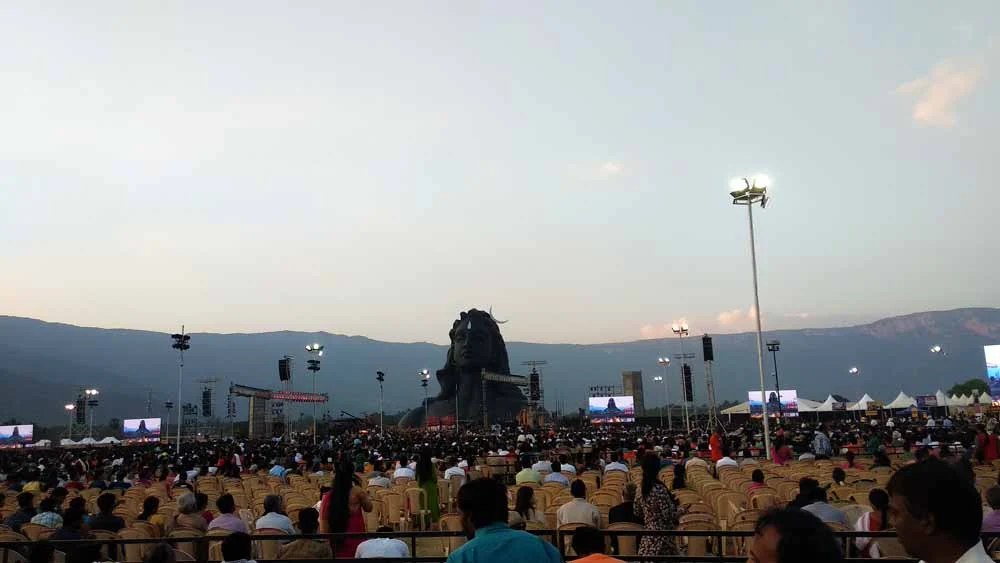
The most striking sight is the Adiyogi. At 112 feet, it is recognised by Guinness World Records as the world’s largest bust sculpture, and its presence stays with you long after you leave. Adiyogi means “the first yogi”, a name for Shiva, and Sadhguru established the figure in 2017 to inspire people towards inner wellbeing through yoga. The statue, the hills behind it and the people around it come together in a way I have rarely experienced. The place felt both peaceful and alive.
Completing the sadhana at the Dhyanalinga
To complete the sadhana, each of us tied sesame seeds, our alms bowl and three coconuts in a black cloth. We carried the bundles on our heads for about two kilometres to the Dhyanalinga and offered them there. Then we sat in meditation in that quiet space, trying to feel life at its deepest.
About 250 people from different places shared our tent. There was no noise or commotion at all. For three days my phone, wallet and other belongings lay open on my bed, and nothing was disturbed. On a journey built on trust, nobody let anyone down. I suppose that someone who has completed Shivanga Sadhana sincerely has little room left for such thoughts.
The night climb: seven hills in ten hours
After the closing rituals, at about 8 pm the same evening, we set off for the seven hills. I carried a light dinner, about three litres of water, a torch and a few essentials. Devotees believe that Shiva resides on the seventh hill.
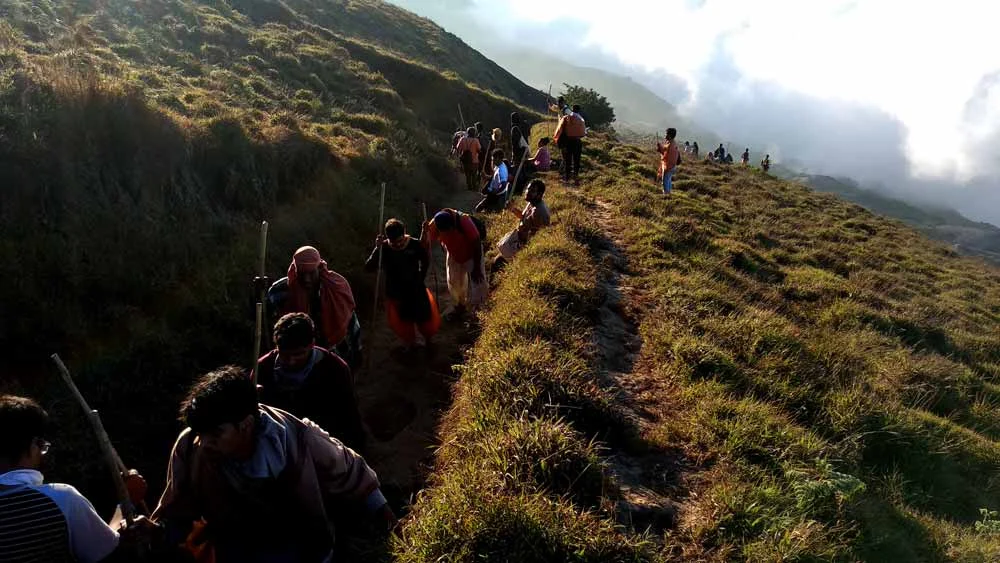
The seventh hill stands at roughly 6,000 feet, and reaching it means covering 14 to 15 km of difficult path. Women are not permitted to make this climb. Because elephants and other animals move through the forest at night, we walked in groups and kept close together. A bamboo walking stick is essential, especially on the way down.
The first three hills
The first hill, which I knew as Mulahara, took us straight into the forest, with trees pressing in on both sides. After a while my breathing grew heavy, but the lights of the city below at night lifted my spirits. Although it was February, the heat and the constant climbing soaked me in sweat.
About an hour and a half later, we reached the second hill, Swadhisthanam. Like the first, it is covered in rock, but it is much harder to climb. The step from one rock to the next is often two or three feet. Think of how tiring it is to climb to a fifth floor on six-inch stairs at home, and then imagine this.
The third hill has fewer rocks. Near its end we came upon a stream called Kaithatti Sunai. Tired as I was, the sight of the water alone felt cooling. Experienced pilgrims carried only a little water and refilled their bottles here. I understood then that every extra thing you carry becomes extra hardship.
The fourth to sixth hills
The third hill took less time than the first two. The fourth, Anahatham, is similar in shape to the third. The fifth has fewer rocks, but its constant ups and downs made walking difficult. At times my legs simply refused to go on, and only my will kept me moving. One thought kept coming back: why did I ever come here? I had already decided I would never return.
It was about 2.30 am when we were climbing the sixth hill. Its soil is the colour of the sacred ash we apply to our foreheads. A stream runs at the end of this hill too. By now the cold had grown sharp, yet I could not resist bathing in that clear water. Hard as it may be to believe, every trace of pain and fatigue seemed to vanish the moment I finished. I set off again with fresh energy.
The final climb
Our goal was the summit of the seventh hill. Dawn was slowly approaching as we followed a winding path through medicinal plants. I was a little frightened on this hill; if I slipped, I had no idea where I would land. Many people had already turned back. Climbing carefully, after nine or ten hours on the move, we reached the top while it was still dark.
Sunrise above the clouds
The cold and the wind made my whole body shake. I wrapped my gamosa around me and offered prayers at the temple, where everything was done in an orderly way.
As the light came up, I felt as though I were in heaven, completely removed from the world. Looking down, I could see only drifting clouds, a sea of them, with us above it. The sun rose slowly through the clouds. The green hills standing alone among them and the soft early sunlight revived my tired mind. It is a feeling I cannot fully explain in words.
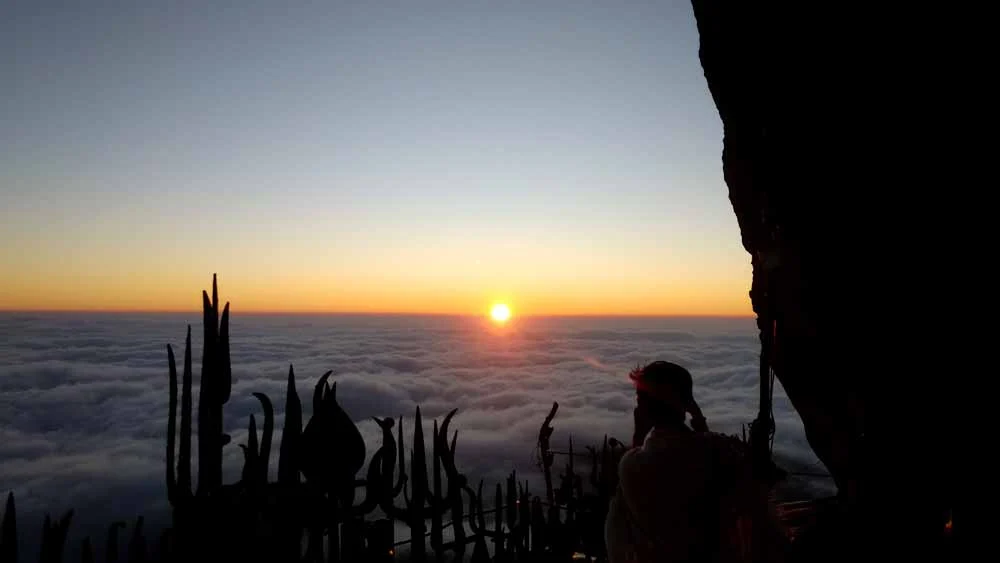
We meditated there for a while and then began the descent. Coming down was much harder and more dangerous than going up. On the way, birdsong and the smell of the dense forest kept me company. We reached the ashram at about 3 pm.
A man who had completed the Kailash Mansarovar trek told us that this climb was harder. The trek demands a fit and healthy body, and only then did I understand why the 42-day sadhana includes a process to strengthen the body.
I normally sleep very little, and sleep rarely comes even when I try. That day, I fell asleep the moment I lay down and woke only the next morning.
Mahashivratri at the feet of Adiyogi
On the day of Mahashivratri we would stay awake all night at the celebration below the Adiyogi. At midday I went to bathe in the specially built Suryakund. Bathing here is said to support physical, mental and spiritual wellbeing. Dipping into the ice-cold consecrated water filled me with calm, in a setting that was utterly silent. After lunch at the ashram we rested a little, and in the evening we made our way to the Adiyogi.
India celebrates many festivals for spiritual growth, and the Mahashivratri organised by Isha is among the best known. Those who had completed Shivanga Sadhana had a separate seating area. The event at the foot of the hills felt like an ashram from the Satya Yuga, with people in every direction.
We were about 300 metres from the stage, and the crowd stretched another 500 metres or so behind us. From that distance the stage was hard to see, so screens had been set up at intervals. Around three lakh people had come from across the world. Vice President M. Venkaiah Naidu attended as the chief guest. All night, well-known artists from India and abroad presented music, dance, and sound and light shows. Stalls of tribal crafts and exhibitions nearby brought together different parts of India’s culture.
In the morning we left the ashram, content with what we had received, with hope in our eyes and a wish in our hearts to return.
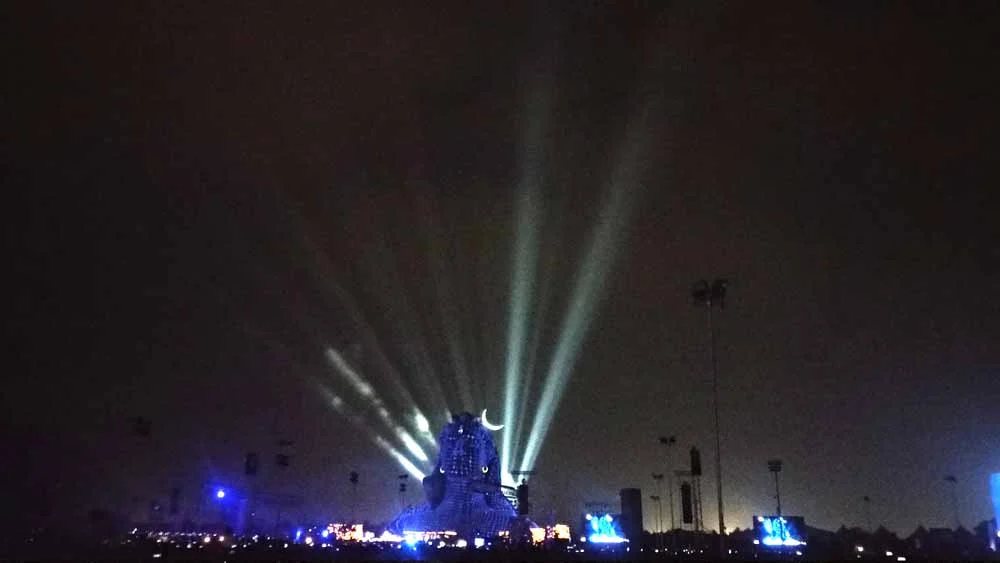
The light show at Adiyogi on Mahashivratri night.
Practical notes for the Velliangiri trek
If my account makes you want to attempt the climb, these points may help.
- Season: the hills are usually open to trekkers from February to May. Check the current dates with the Tamil Nadu Forest Department or the temple authorities before planning.
- Who can climb: by local custom, women between about 10 and 50 years of age are not permitted to climb.
- Fitness: the trek is long, steep and rocky. Prepare your body in advance and do not underestimate the descent.
- What to carry: a bamboo walking stick, a reliable torch, light food, and modest amounts of water that you can refill at the streams. Carry as little as you can.
- Night safety: climb in a group, because elephants and other animals use these forests at night.
- Weather: expect heat and sweat on the lower hills and strong, cold wind on the summit before sunrise. Carry a warm layer or shawl.
Closing thoughts
The 42 days of Shivanga Sadhana prepared both my body and my mind for the hardest climb I have attempted. Asking strangers for alms humbled me, the seven hills tested me, and the sunrise above the clouds on the seventh summit is something I still cannot put fully into words. That night under the gaze of Adiyogi, among lakhs of people, I understood why so many come back.
Written by: Pranabesh Barman
References
The account is the author’s own experience. These sources support the factual points around it.
- Guinness World Records: Largest bust (sculpture): Adiyogi, 34.24 m (112 ft 4 in) high, verified 11 March 2017.
- Isha Foundation: The second Guinness World Record for Isha Foundation
- Wikipedia: Adiyogi Shiva bust: dimensions and unveiling on 24 February 2017.
- Business Standard (PTI): Vice President to attend Shivarathri celebrations at Isha Yoga, 18 February 2020
- Free Press Journal: VP Venkaiah Naidu joins Sadhguru in Maha Shivratri 2020 celebrations
- Covai Post: Isha Yoga Centre gears up for Mahashivratri, 17 February 2020: 26th celebration, 21 February 2020, 6 pm to 6 am.
- Isha Foundation: Over three decades of Mahashivratri celebrations
- eSamskriti: Velliangiri Hills, the Kailash of South India: trek difficulty, start point at Poondi, Kaithatti Sunai stream, rules for women.
- Lokmat Times: Trekking season at Velliangiri Hills from 1 February to 31 May
- Bharatpedia: Velliangiri Mountains: Sapthagiri, altitudes and pilgrimage season.